This review was written for The Friday Times. Published on 28 August, 2025.
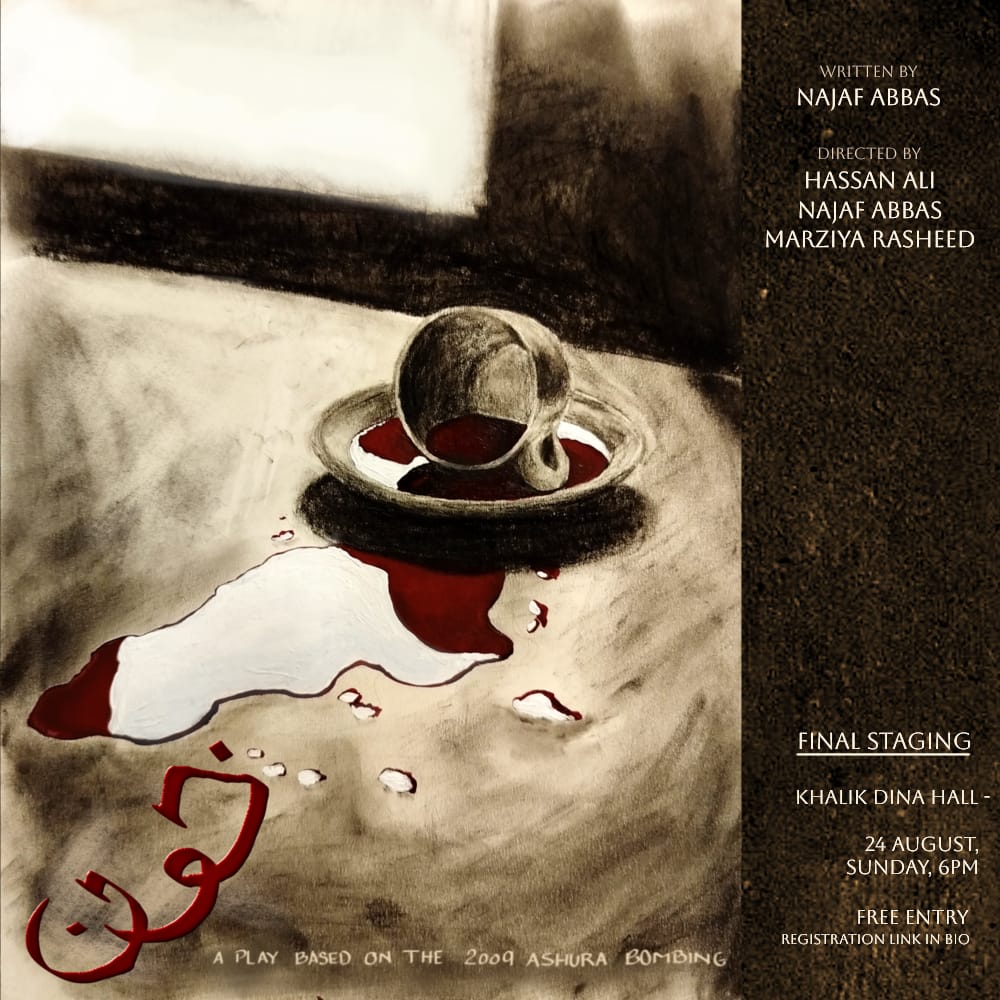
The final staging of Khoon, written by Najaf Abbas and co-directed by Abbas, Hassan Ali, and Marziya Rasheed took place on 24th August at Karachi’s Khaliqdina Hall. The play centres on the events of the 2009 Ashura blast near Karachi’s Lighthouse bazaar, following two families who deal with the immediate aftermath of the bombing.
Ali-Asghar (Haider Zaidi), the 16-year-old son of Fatima (Sukaina Reza) and Ali (Jafar Hassan) is missing on the Day of Ashura, the 10th Day of Muharram when mourners commemorate the martyrdom of Imam Hussain at Karbala in 61 AH/680 AD. Just the night prior, his parents had not allowed him to go to the main jaloos (procession) in Karachi, despite his father and his friend Umer (Naaseh Sajid) going.
Come Ashura, Fatima discovers that Ali-Asghar is not home. At first, she thinks that Ali-Asghar’s locked bedroom door is a sign that he is upset having not been allowed to go the jaloos. Meanwhile, Fatima has already learned from a phone call that a blast had occurred in the jaloos. Despite Ali and Umer still not having returned home, she keeps her composure and tends to guests who are visiting, who are distressed with the news from the bombing.
With their help however, the door to Ali-Asghar’s room is broken, where they discover that it is empty. Now a sense of dread befalls Fatima.
Meanwhile, Ali and Umer return home, who now learn as well that Ali-Asghar is missing. Ali leaves to search for his son (despite Umer offering to). His friend is left at the house taking care of Fatima.
Umer’s character opens a different arc to the play, one which explores Shi’i and Sunni dynamics in contemporary Pakistan. Umer is Sunni, and is not only admonished by his brother Zia, but also by Ali’s relative Haider. By Zia, for having gone to a majalis, jaloos, and bringing niaz back to their home, and by Haider, who in an earlier scene expresses that he thinks Umer is a fraud and has no business being a part of their mourning.
While Khoon has strong acting throughout, Sukaina Reza’s character Fatima provides a stellar performance that takes the audience through a rollercoaster of emotions
Later while Ali is back at the jaloos, Haider comes in and when he sees that Umer is present, accosts him by asking “After all of this (the blast), you’ve come to this house?”, questioning Umer’s motives once again.
When Ali returns, he breaks the unfortunate news to the room, which at first is stunned, and then the parents break down sobbing. Haider and Umer are unmoved at first, unsure of how to act. Haider then approaches Ali and says that his son is now a shaheed (martyr), at which Fatima screams that her son was just a 16-year-old child, not a soldier. Haider is asked to leave by Ali, but while leaving Haider quips how he is being asked to leave, but Umer is not.
Now Umer approaches Ali, who is in a daze, and after a long silence, starts lambasting his friend. Umer protests that he was part of the jaloos, and also of the majalis that took place. Ali asks Umer if he will go to the Chelum procession, and on Umer’s silence, Ali screams that he will still go, because if he does not, azadari would stop.
This part of the play becomes particularly poignant, given that in 2010 when Chelum was being observed in Karachi, a bus carrying mourners was targeted in a bomb blast on Shahrah-e-Faisal near Nursey, killing 12 people. Later that day, in the emergency area of Jinnah Hospital where victims from the first bombing were being treated, another blast took place killing 10 more people.
In the final act of the play set in an imambargah, a dastarkhwan is laid out. Ali and Umer hug, but Haider refuses to shake Umer’s hand. The characters sit at the dastarkhwan as the curtains close.
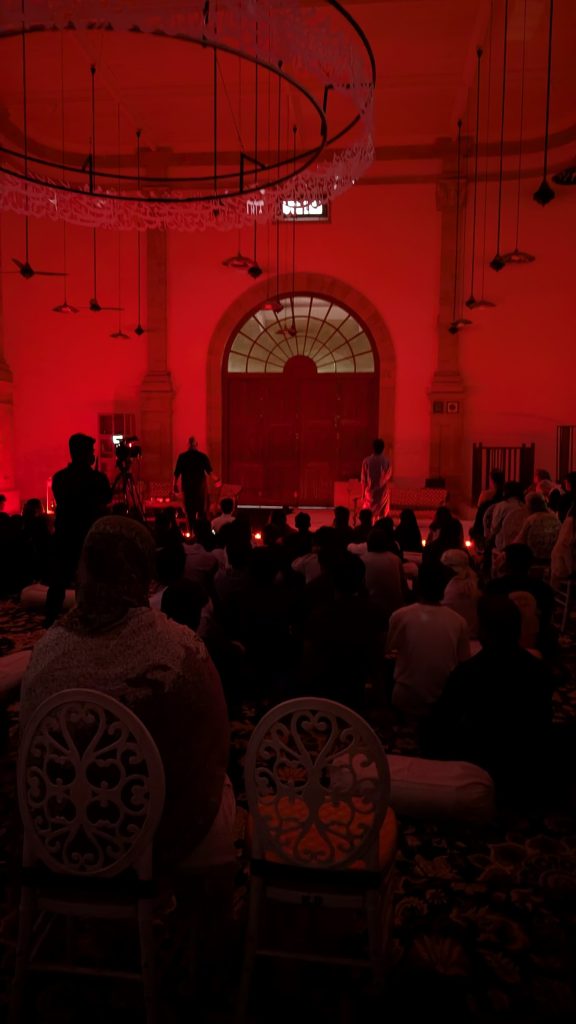
The play itself has some of the requisite parts of a majlis. The audience enters to a recitation of marsias and the play begins with a noha. The audience is also engaged by the call to salawat, and laced throughout the play are more marsias.
While Khoon has strong acting throughout, Sukaina Reza’s character Fatima provides a stellar performance that takes the audience through a rollercoaster of emotions, from her plea to not let Ali-Asghar go to the jaloos, to her comforting of guests who visit after news of the blast, and ultimately learning about the death of her son. She undertakes the labour of a mother, whose entire time is spent in providing comfort to others, but does not receive nearly the same in reciprocity.
Khaliqdina Hall is a sombre location given that it is barely more than half a kilometre from where the Ashura blast took place on 28th December 2009. It is also close to Karachi’s city court, which is itself in the immediate vicinity where the bombing took place. Just a year after the bombing, accused Jundullah militants fled the police in a dramatic grenade attack and subsequent shootout outside the court, where three terrorists escaped, and one was killed alongside a police officer.
Credit must be given to the Karachi Metropolitan Corporation (KMC) who in recent years have renovated the space for it to be able to hold performances like these. Though not the most ideal place to hold a play, given the lack of tiered seating/stage, it is still admirable that the space can now be used for a myriad of events. Established in 1906, Khaliqdina Hall had served as a library and community centre, but decades of neglect despite its historical significance of having hosted events of the All-India Muslim League (AIML), and the sedition trial of Muhammad Ali Jauhar, it had fallen into disrepair.
The 2009 Ashura bombing in Karachi killed 45 people with several more injured. Hundreds of shops in the immediate area were burned down. The bombing followed a litany of threats by militant groups including the Tehreek-e-Taliban Pakistan (TTP), Lashkar-e-Jhangvi (LeJ), and Jundullah. As the writer of the play says in a speech once the play was concluded, the event had a marked impact on Shi’i narratives of resilience and azadari.
Khoon perhaps questions this idea of resilience as well, which in the 2010s after a spate of terrorism and climate-disasters in Pakistan, was brandished as the country’s moniker in international forums and local seminars.
Just how resilient is one expected to be?
Related Essays
tags: karachi, urban life