This piece was written for Dawn, EOS, published on 31 August, 2025
Hiroshi Yoshida (1876-1950), in making his woodblock print Shalimar Garden, Lahore, not only brilliantly captures the reflection on the water of the people, trees and marble structure, but seizes in time two subjects that have disappeared. The trees have all gone. The original marble pavilion was pillaged during the time of Ranjit Singh and was likely replaced by another marble. However, even that marble appears covered by some sort of a lime plaster or red sandstone.
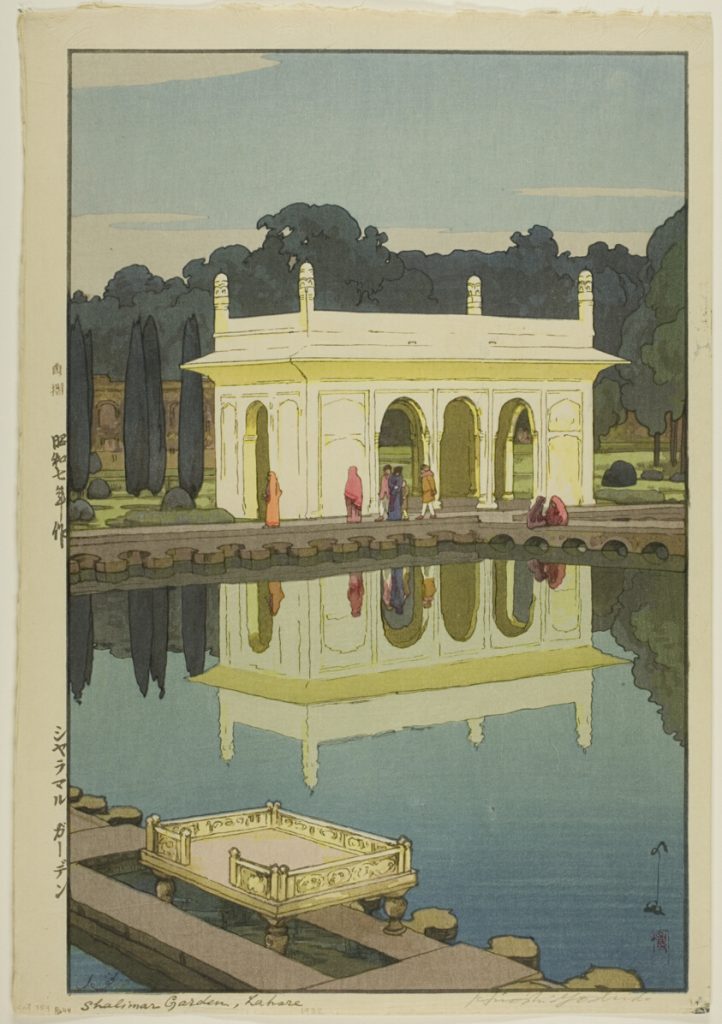
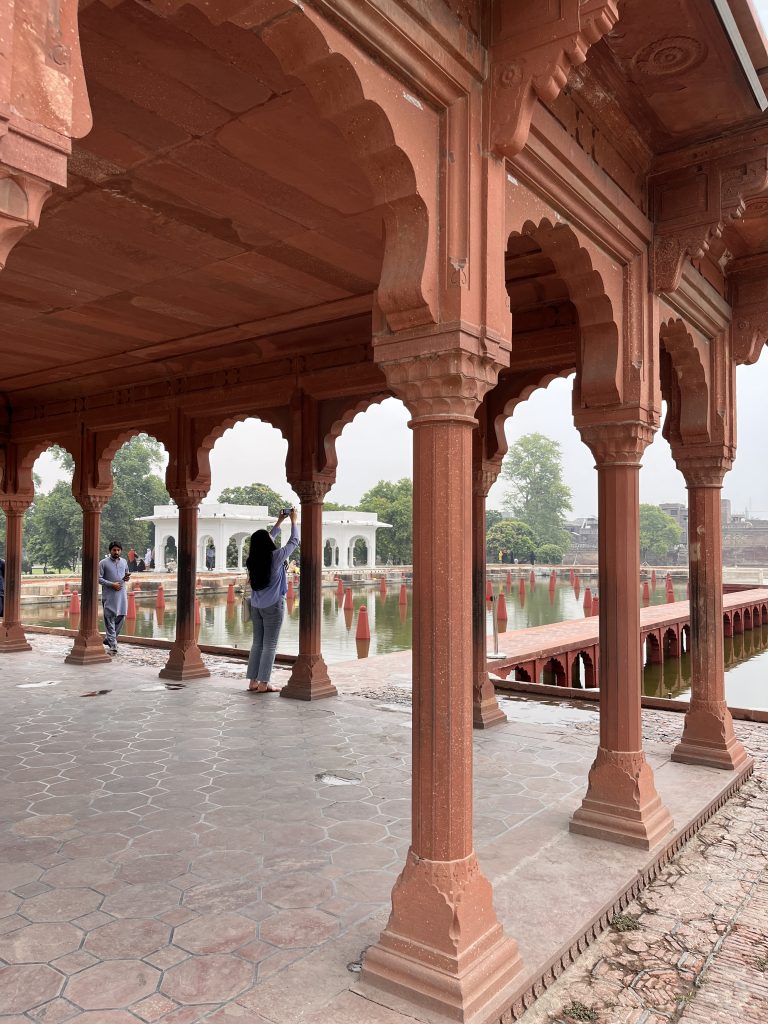
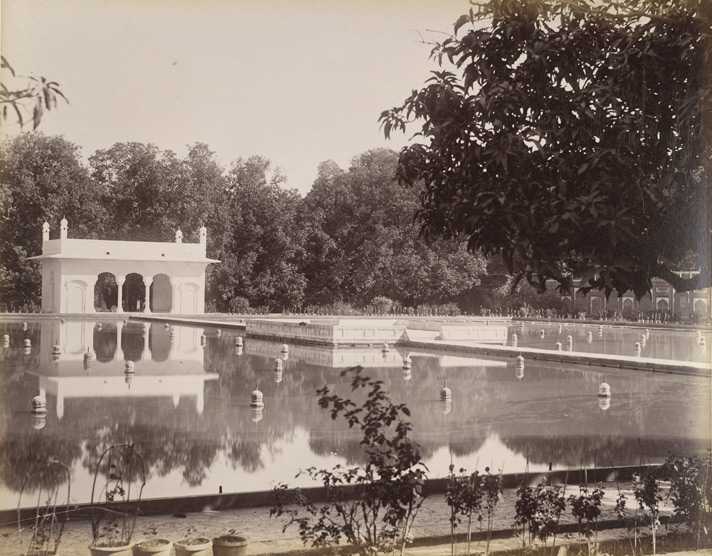
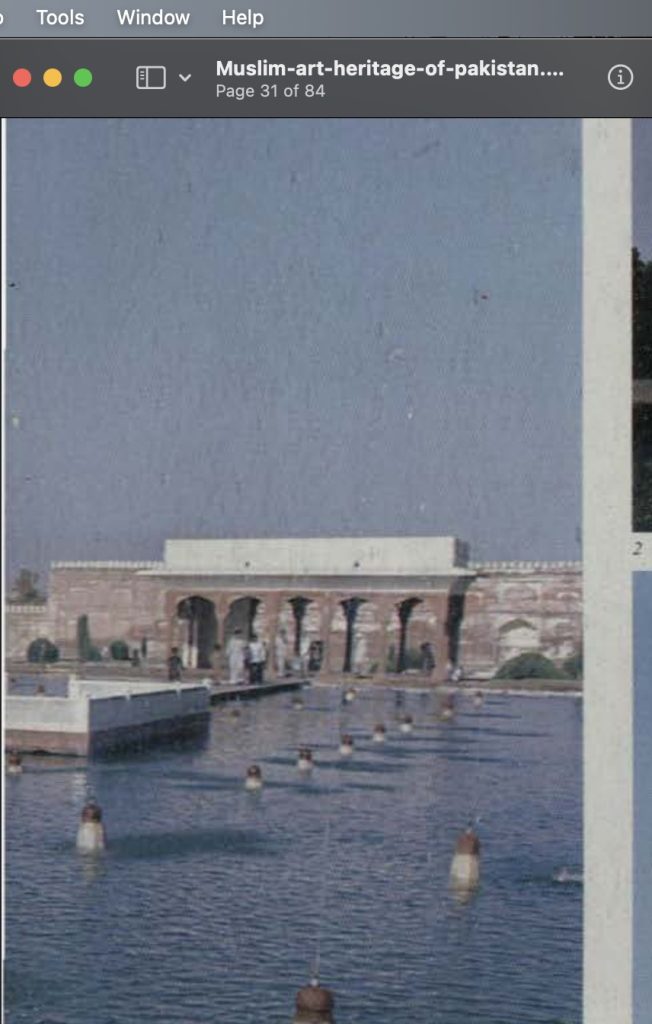
At first glance, it seems that Yoshida took some artistic license and imagined this structure, since the present Shalimar Bagh does not have it. However, looking at an image of the Bagh published in 1908, one finds that the marble mahtabi in the middle was connected to the two replaced marble pavilions, which even the ones that Yoshida saw might have been reproductions of—the original marble was pillaged to construct the Ram Bagh in Amritsar. In an image found in a 2008 book by the Ministry of Information and Broadcasting, a marble roof exists, but the pillars are red.
Shah Jahan’s Legacy
It is almost poetic that Yoshida chooses the Shalimar Bagh water tank as one of his subjects for his minute collection of works from modern-day Pakistan — his work from India on the same trip is much more expansive. Shah Jahan had specially built a canal to water Shalimar Bagh and a Japanese artist coming to capture it in search of how light and water interact in South Asia would have pleased the emperor.
Following the end of Japan’s Edo period (1615-1868), the popular ukiyo-e art genre’s woodblock prints, which were an inexpensive form of art available for the masses, were dying. To revive this art form, the shin-hanga [new prints] movement began and Yoshida became one of its greatest proponents.
Nearly a century ago, a Japanese printmaker was inspired by Shah Jahan’s Shalimar Bagh. Today, his art continues to inspire
Reinvention and Travel
Already highly successful with his oil paintings and watercolours, Yoshida learned about the West’s interest in ukiyo-e, which also prompted the change. Though his work on Japan alone would have established him as one of the greats of shin-hanga, he made regular trips to North America and Europe in the 1920s, making woodblock prints of the Grand Canyon, Mt Rainier (now Denali), the Acropolis and the Matterhorn.
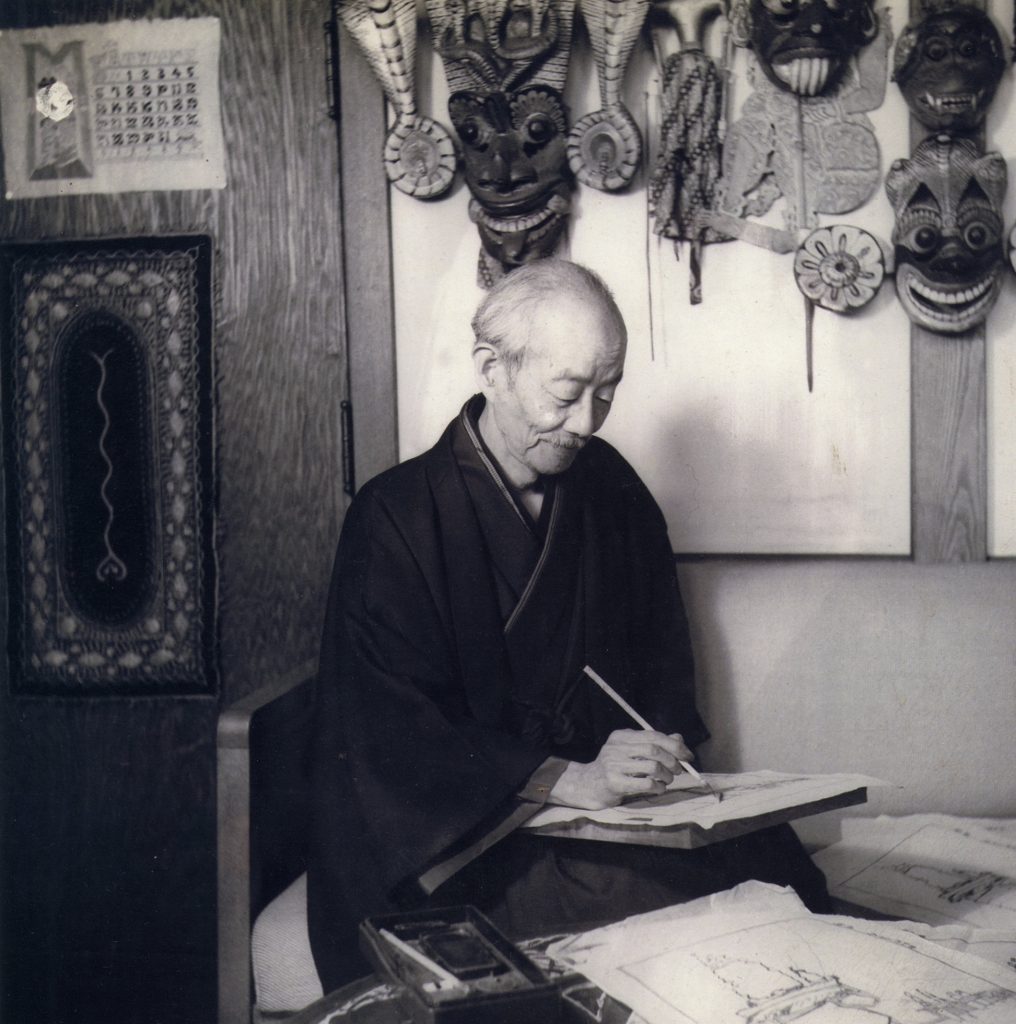
The scholar Dorothy Blair, in an obituary for Yoshida published in Aribus Asiae, writes how the artist was meticulous in both his choice of paper and wood when making the prints. During and after wartime in Japan, the most commonly available paper was mixed with pulp, as had become common in the West. Yoshida would then go directly to native makers, preferring a hosho paper produced in Odaki, in Fukui Prefecture.
Yoshida would also teach his techniques, not only by publishing Japanese Wood-Block Printing in 1939, but also by helping Westerners who tried learning woodblock prints. For one US Army medic stationed in Tokyo, Yoshida had him hold an egg with his cutting knife. If the egg broke, a softer touch was needed.
His trip to northern India and Southeast Asia in 1930 with his son, Toshi Yoshida. His prints capture a sense of religiosity and grandeur. Typically, Yoshida’s prints depict nature, but the South Asia series has a certain reverence, with the inclusion of mosques, gurdwaras and temples, and which nearly all include people.
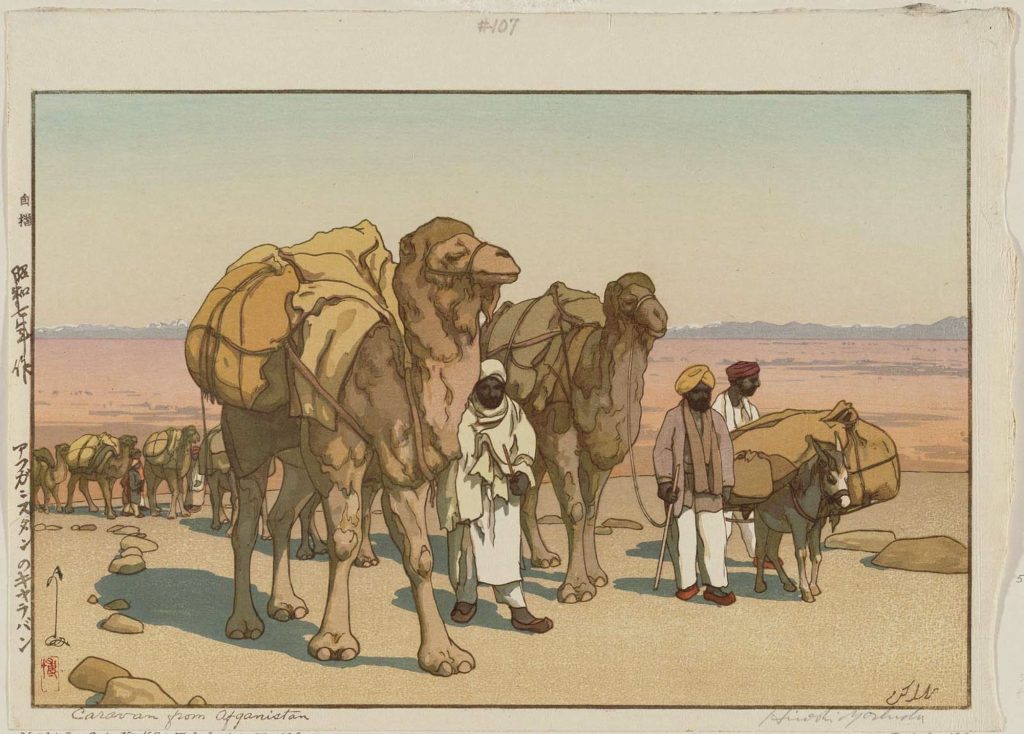
In his modern-day Pakistan prints, he also includes a day and night scene of Lahore from the outskirts and Afghan traders passing by, also at day and night.
A Centenary Approaches
Throughout the decades since the prints were first made, there has been regular interest in Yoshida’s South Asia collection. In the summer of 1999, the Smithsonian Institution’s Freer|Sackler (now named the Smithsonian Asian Art Museum) exhibited all 32 of Yoshida’s South Asia prints.
In more recent years, Yoshida was exhibited from June to September 2015 at the Ashmolean Museum at Oxford, under the title, ‘Hiroshi Yoshida: A Japanese Artist in India’, on loan from the Lahiri Collection. This included the print of the Afghan caravan and the scene outside Lahore.
In 2024, the Ashmolean acquired a Shalimar Garden print and one could imagine why. In a few years, a centenary will pass from when Yoshida made his South Asia prints, and the time it seems would be right to begin a further examination of his work, South Asian and Japanese art connections, and preparations for exhibits.
A poster of Hiroshi’s Shalimar Gardens is available for sale on Pakistan Art Archive.