This review was written for The Friday Times. Published on 17 September, 2025
A remarkable book has been added to cricket annals, and though a slim collection, its wealth and compilation of information makes it an important book not just for cricket fans, but those interested in the history of Karachi.
Karachi’s historical diversity comes to the fore in Non-Muslim Cricketers of Karachi, and Shah Waliullah Junaidi sets out to celebrate the city’s religious and cultural fabric. The result is a neatly compiled account that not only highlights forgotten sporting figures but also sheds light on civic life in Karachi itself.

Junaidi must now be noted as a veteran chronicler of Karachi’s past, his previous works include North Karachi Ka Qayam, Shakhsiyat Aur Halaat (The rise of North Karachi, personalities and situations), Yeh Shahrah-e-Aam Nahi: Karachi Ki Yadgar Sarkain (This is not a public thoroughfare: Memorable roads of Karachi), and Shikasta Tehzeeb: Nazimabad and North Nazimabad (Declining Civilisation: Nazimabad and North Nazimabad).
In this book, he approaches his subject with the care of a historian and the passion of a cricket lover. His book traces the journey of Parsi, Hindu, Christian, Jewish, Sikh, and Ahmadi players who shaped Karachi’s cricketing landscape from the colonial era to modern-day. Each chapter begins with a social history of how the community shaped cricket and the city, and then a list and portraits of cricketers with short biographical notes. Junaidi is also careful to include those who might not have played cricket, but served as administrators, patrons, or commentators of the sport.
From the Parsi Institute where Hanif Mohammad made 499 to the Jewish cricketer who played under Hanif’s captaincy, this book recovers a world that is difficult to imagine today
While the players discussed are predominantly born in Karachi, Junaidi also includes those who later either settled in Karachi, or played a significant number of matches for a team in Karachi.
The book opens with Parsi cricketers, which is an important consideration. Parsis were amongst the first to have picked up cricket in the Subcontinent, and Parsi teams regularly toured England during the British Raj. As has been discussed in great detail by historians such as Prashant Kidambi, some of the most important cricketing matches played in Mumbai were between Muslim, Hindu, and Parsi clubs, which as Junaidi notes was replicated in Karachi with the addition also of a Christian team. The Karachi Parsi Institute (founded in 1893) became one of the city’s earliest cricket nurseries, and was the famous site of Hanif Mohammad’s 499 against Bahawalpur in 1949.
At Partition, three members of Pakistan’s Test team had previously represented India. Abdul Hafeez Kardar, Gul Mohammad, and Amir Elahi. Junaidi reminds us that there was very nearly a fourth. Jamshed Khudadad “Jenni” Irani represented India in two Tests as a wicketkeeper, but was not selected to play for Pakistan. Age might have been the issue, with Jenni being 35 when Pakistan became independent. However, he did stand as an umpire in a first-class game between Pakistan and a Commonwealth XI.
Non-playing members of the Parsi cricket community include Kaikhusroo Collector, who served as the first President of the Board of Cricket Control in Pakistan (BCCP), and Jamsheed Marker who became a noted commentator and cricket writer.
From there, the narrative turns to Christian cricketers, particularly Goans, who supplied a steady stream of players to Karachi’s domestic teams. Wallis Mathias was the first Christian to play for Pakistan, but it could have been Jack Britto, who in 1949 had to decide playing cricket against a touring West Indies, or hockey in Europe. He chose the latter. The second Christian to then represent Pakistan became Antao D’Souza.
Junaidi includes the stories of school-level cricket at institutions like St Patrick’s High School, and the establishment of the Goan Association Gymkhana in 1925 by Cincinnatus Fabian D’Abero (also the founder of Cincinnatus Town, now Garden East) further illustrate how Christian communities built pathways of opportunity through sport.
Amongst non-playing cricket personalities listed is also listed Bernard “Ben” Lawrence, who despite being born in Lahore, studied at St Patrick’s and settled in Karachi. Lawrence became one of Pakistan’s primary scorers and statisticians, later publishing compilations of statistics and scores as well.
Junaidi places Christian Anglo-Indians separately from Goan Christians, and these are individuals who mainly participated in communal tournaments in Karachi under the banner of “Europeans,” or in a combined Anglo-Indian and Goan team. One such individual is Claude Blake Rubie, who was born in Sussex in 1888, but played for Sindh and Karachi. Later becoming a cricket administrator, he was responsible for drafting the first constitution of the Indian Cricket Board, and also the Rubie Shield, an inter-school tournament that led to rapid youth development in the sport.
At the time of Partition, Karachi’s Hindu population constituted half the city, but was reduced to just 7% when the split occurred. Junaidi’s chapter on Hindu cricketers of Karachi, understandably centres on Naoomal Jeoomal, who represented India in their inaugural Test, played at Lord’s against England in 1932. Jeoomal later stayed on in Pakistan, but emigrated to India in the 1970s.
Also mentioned is Bhudhaji Devi Shanker, who did his schooling from N.J.V High School and later co-authored alongside Claude Rubie A History of the Sind Cricket Tournament and Karachi Cricket in General (1929).
Anil Dalpat became the first Hindu to represent Pakistan, and his cousin Danish Kaneria the second—remaining the only two Hindu players to represent Pakistan at the highest level.
One of the book’s most intriguing sections deals with a Jewish cricketer from Karachi, Isaac Solson (Solomon), who Junaidi notes played for various clubs including Pak Crescent, which was led by none other than Hanif Mohammad. Solomon later moved to Israel and then to Florida, and also wrote his memoirs aptly titled, A Jewish Cricketer from Pakistan. Amongst communal migrants also included are Ahmadis, with brothers Faisal bin Mubashir and Rafay Ahmed who played the Quaid-e-Azam trophy in Pakistan, but later moved abroad.
A lone Sikh cricketer is mentioned, Malawa Singh, who captained a Karachi Port Trust (KPT) side, yet no statistical records are available.
In recent years, cricket books from or about Pakistan have focused on histories of Pakistan cricket at large, but few examples exist where authors have taken their time to painstakingly piece together what are local narratives. However, considering Karachi’s size, future projects might make the radius even smaller. The book also features a foreword by Qamar Ahmed, who would have been an invaluable source of advice and knowledge.
Non-Muslim Cricketers of Karachi is an important contemporary contribution to Pakistan’s sporting historiography. For cricket enthusiasts, it offers a treasure trove of forgotten names and matches. For students of Karachi’s history, it situates sport as part of the city’s civic life.
It is difficult to imagine today the communal tournaments and the sheer diversity of the city that Junaidi illustrates for the reader. The past is another planet.
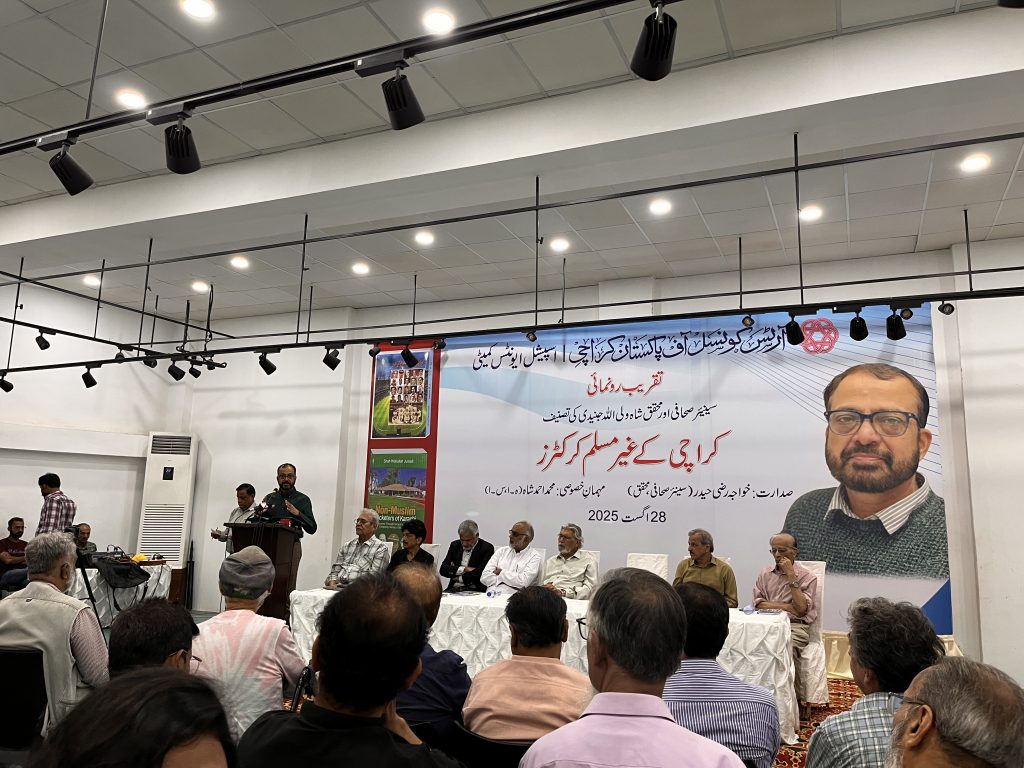
Note: Non-Muslim Cricketers of Karachi: A Journey Through Karachi’s Forgotten Cricketing Heroes (1886-2024) was launched at the Arts Council of Pakistan, Karachi, on 28 August 2025.
Related Essays
tags: karachi, urban life