This piece was written for Dawn, EOS, published on 16 November, 2025
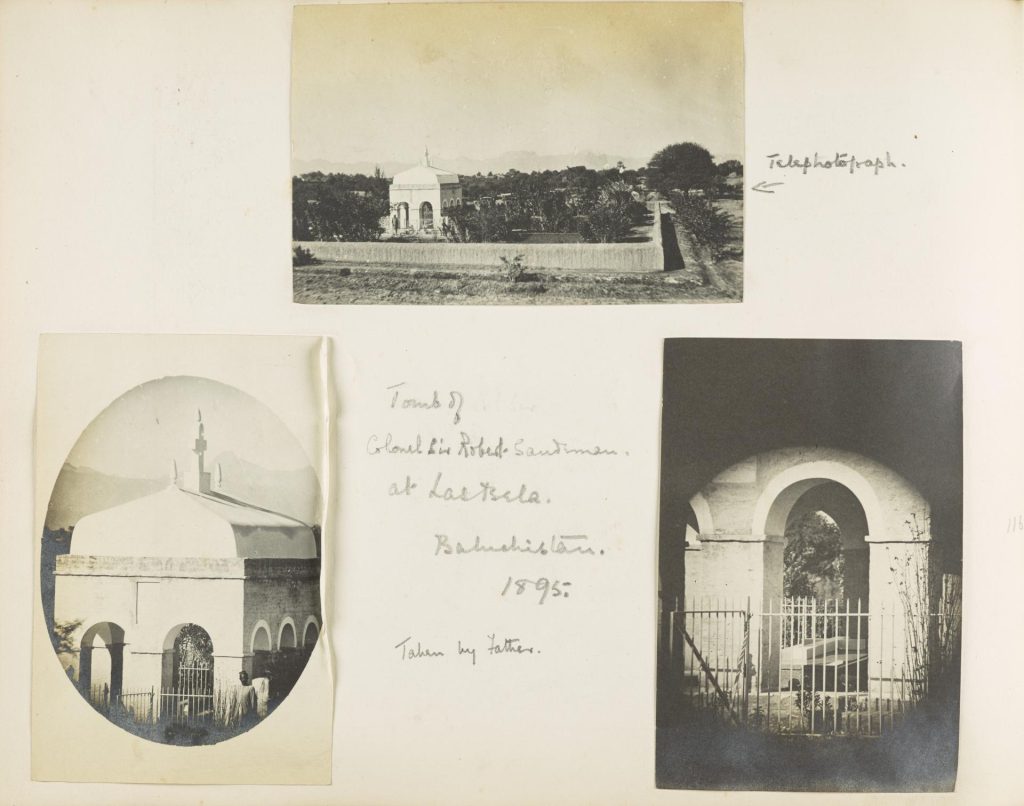
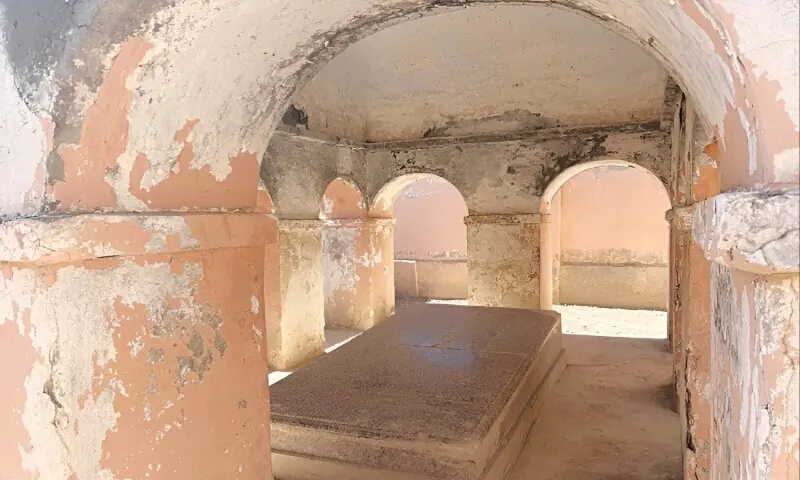
An 1895 photograph in Las Bela by Colonel Patrick Alexander Weir, a British medical officer serving in British India, shows a small mausoleum where a cross stands on top of a dome, and another large cross is placed on the tomb itself. Today both the cross on the tomb and dome are gone, and the site is fast approaching dereliction. Nearby at Bara Bagh, is a necropolis that also hold the tombs of the Jams of Las Bela, but they are barely in better shape.
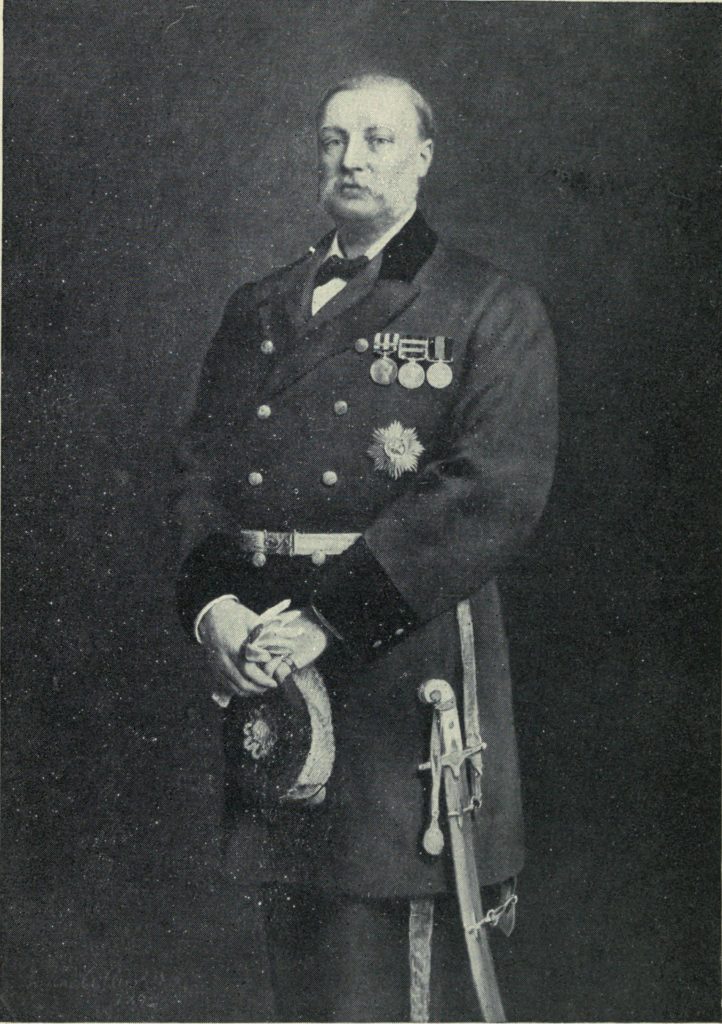
The subject of Weir’s photograph is the tomb of Robert Groves Sandeman, the British Raj army officer who laid down and executed the colonial blueprint in securitising modern-day Balochistan, playing on the suspicions and factions of Baloch groups with one another.
Sandeman was only 57 when he died, just days short of his 58th birthday. He had suffered from ill-health in the months leading to his passing, and had spent the summer in Scotland before coming back to the Subcontinent in November 1891, first spending Christmas in Quetta, and later travelling to Las Bela, which was to serve as his final resting place.
Las Bela had become an important port of call for Sandeman, who served as the Agent to the Governor General (AGG). Under his policy of “Sandemization” political agents of the Raj were placed as “mediators” between khans and sardars. Sardars who formerly sought to seek allegiance of the khans, would now seek British support and protection instead, which strengthened British control in the Balochistan Agency, established by the Raj in 1877. One such sardar was the Jam of Las Bela, who served as a feudatory of the Khan of Kalat. After Sandeman’s intervention, the Khan’s power was weakened.
This was a cruel turn of history, since the formation of the Princely State of Las Bela was only possible because of the Khan of Kalat, Muhabbat Khan. In 1742, at the request of Jam Ali of the Jamote clan, Muhabbat Khan dispatched Mulla Muhammad Hayat to Bela (the largest city in Las Bela) with a large force of Brahuis to capture the city which had fallen under the control of various short-term semi-independent states.
While Lasbela District today is administratively a part of Balochistan, the Jams of Las Bela claim Arab descent from the Sindhi Sammas (1351-1524), who had lost control of the area to the short-lived Turko-Mongol Arghun dynasty. As repayment for the aid in recapturing Bela, the Jams had to pay the Khanate of Kalat either a share of their court revenue, or provide armed support.
However a few generations on, this arrangement did not suit the Jams anymore, and Jam Mir Khan II who took over the clan in 1830, held aspirations to takeover the Khanate of Kalat for himself. This was despite an alliance through marriage with the then Khan of Kalat, Khudadad Khan’s sister, Bibi Alladini. Alongside the other feudatory states of Jhalawan and Kharan, Mir Khan II began insurrections against her brother in July 1865, but was defeated multiple times.
Meanwhile, his son Jam Ali Khan III escaped to Bela to come to terms with Khudadad Khan. Sandeman then brokered an agreement in 1876 where the Khan of Kalat’s suzerainty over Las Bela would be recognized. Mir Khan II was then released from captivity, and at first let his son rule Las Bela. However, Mir Khan II retook the throne amidst quarrels with his son, which ultimately led to Ali Khan III being kept in confinement and disinherited.
At Mir Khan II’s death in January 1888, a crisis of succession emerged since the Jam had disinherited his son. However, Sandeman intervened and proclaimed Ali Khan III as Jam of Las Bela in 1889, after a year of deliberation during which Rai Bahadur Hittu Ram administered state affairs.
Subsequently, the Jamote clan has kept control of Las Bela till present-day. The current Jam of Las Bela is Jam Kamal Khan, who is presently the Federal Minister of Commerce. Also known to go with the winds of whoever has political control, Jam Kamal Khan has been a part of PML(Q), BAP, and PML-N, and served as Chief Minister of Balochistan under the PTI government.
Sandeman and his “isation” were an integral part of developing the British Raj, particularly as they pertain to areas of modern-day Pakistan and Afghanistan. A series of both diplomatic and military efforts guaranteed that British interests were safeguarded in nearly anything that was west of the Indus. This was notable given that it was a time period that could easily have seen more Soviet influence arrive in the Subcontinent following a breakdown of relations between the two empires following the Crimean War (1853–1856), further fueling the Great Game.
In 1880 Afghanistan became a British Protectorate, and Sindh and Punjab were in complete Raj control after the Battle of Dubbo (February 1843) in the former and the Battle of Gujarat (February 1849) in the latter. Sindh, Punjab—and now due to Sandeman—Balochistan, were a part of the Raj.
Final Days
Leaving Quetta for Karachi on January 9, 1892, Sandeman summoned his political officers to meet him at Las Bela, alongside chiefs from Kej and Panjgur. In Las Bela he was to mediate a quarrel between Jam Ali Khan III, now also a Knight Commander of the Order of the Indian Empire (KCIE), and now his son Mir Kamal Khan, who had fled to Quetta.
From Karachi, Sandeman travelled by ship (the government-owned Patrick Stewart) and reached Sonmiani on the 17th. On the 22nd, they reached Las Bela. Sandeman appears to have caught a cold and was later stuck in heavy rain. Jam Ali Khan arranged for horsemen between Las Bela and Karachi, if medicines or more help would be needed for Sandeman.
Pneumonia had however penetrated his lungs, and he died on the 29th. Initially his body was to be taken back to his native Scotland, but the Jam asked that he be buried in Las Bela. It would have been beneficial to house the tomb of the man who held such power in Balochistan, with its upkeep showing loyalty to the Raj.
In Colonel Sir Robert Sandeman: His Life and Work on Our Indian Frontier by Thomas Henry Thorton, Sandeman’s wife writes the chapter on his final days. She mentions that the Khan of Kalat wrote to her saying that Sandeman should either be buried in England, or within the Khan’s dominions. If the Jam were to object, he was prepared to send an army.
It is unlikely that the body would have been sent to Kalat territory however, since the Raj was wary of the power the Khan of Kalat could potentially hold again in Balochistan. In a letter days before his death on January 12 from Sibi to George Curzon (the future Viceory of India) Sandeman wrote “I do not say that the Khan is all that we could desire—very far from it. He has his own aims of course, and he cannot forget or forgive the sirdars for their successful rebellion.”
His letter also shows why the British had tried so desperately to establish some writ in modern-day Pakistan and Afghanistan, writing, “There cannot be a doubt of the fact of the Russians being most active on the Seistan [Sistan] frontier; our Government out here seem now to admit it”.
The Burial
Sandeman’s burial was held three days after his death, on February 1, with the grave less than a mile from where he proclaimed Ali Khan as Jam of Las Bela. The Jam had this site selected since it was visible from his house, and where he could “look at it when saying his prayers” according to the chapter by Sandeman’s wife.
Following a temporary arrangement for the grave, Ali Khan erected a dome 6 months later, complete with an inscription bearing his name. Sandeman’s wife also had sent over a tomb made of Aberdeen granite and white marble. A garden was planted around the dome, for which a gardnener was employed who lived in a house by the grave. Iron railings were installed both around the grave and the dome, and a wall around the garden with an iron gate.
Sandeman’s tomb is not the only grave of a former British commander in modern-day Pakistan. The most famous example is of Lord Jacob in Jacobabad, and even Mortimer Durand’s father, Henry Marion Durand was buried in Tank, D.I. Khan. Despite acuqiesing first to the British Raj and later to Pakistan, little has changed the fortunes of modern-day Las Bela.
Further Reading
tags: balochistan, state formation, british colonial, historical narrative